
The Saltwater Magazine for Gulf Coast Fishing!
Search Gulf Coast Fisherman's
Web Site

Jack Attack!
by Capt. Fred EversonWinter 2007
January thru March is prime time for jacks on Tampa Bay.
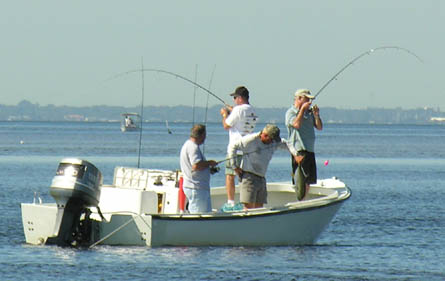
- It is a coolwinter afternoon and we are coming across the flats from
Tampa Bay into the mouth of the Little Manatee River. The water is literally
beaten to froth covering an area that has to be acres.
- "Can that really be fish?" asks my buddy John.
- "Yeah man, that's one massive Jack attack. Let's get 'em!" I reply.
- We storm to the edge of the school on plane, just within casting distance and I shut the engine down. I have a long, limber flats rod rigged for redfish with weighted jerk bait, but you could put a hook in a two by four and toss it into this melee and catch fish with it.
- I'm thinking to myself that this rod might be a little light for these fish, which look to be in the 15-pound class. I toss the jerkbait into the mix and soon as it hits the water I'm hooked up.
- The eight and a half foot rod bends in a long, graceful arc as the
reel's drag whines. John is hooked up too, and once the fish reach the
end of their first run, they begin to circle the boat. John and I do the
under over thing several times passing each other as our fish circle in
opposite directions, and somehow we avoid a tangle. I have my fish to the
boat in about 20 minutes good time for the limber flats rod. John
is not far behind me landing his fish. The school is still beating the
bait up on the surface a hundred yards away.
- "Let's do it again!"
- The next fish is even bigger than the last and takes nearly 45 minutes to bring to heel. That's about all the jack I need for a day as my right wrist is beginning to turn to Jell-O. John's had it too, and the jacks are still frothing all around the boat, so we leave them biting.
- I never, ever pass up a school of these rod benders. Yeah, I know, they aren't supposed to be good to eat, but I don't know that for sure I've never tried one. But I do like catching them, especially on my flats tackle. Few fish are stronger or fight harder than jacks in fact, none that I can think of. They use their flat shaped, muscular bodies to great effect about like trying to reel in a five gallon pail with fins and a tail -- and an attitude.
- Then there are those occasions when they won't eat anything. You might see a big school of jacks on the surface just cruising, pushing lots of water as if they have someplace to go. These fish will certainly cause frustration, but just because you can see them, doesn't mean you can catch them.
- We have jack crevalles in Tampa Bay all year long, but it is in late fall and winter that we see the big fish, 15 pounds and up. Like all fish, there are times when they won't eat, but those are hardly the norm. When they are tearing it up on top, my guess is they would hit a bare hook if you moved it through them fast enough.
- I used to like to throw surface plugs at them, but one time I got into a school of really big fish and they inhaled the lures so deep that I had to cut them out, killing both fish. Most recently I was throwing a Zara Spook around docks at the mouth of the Little Manatee River looking for snook. Instead I hooked a willing jack, which in turn hooked me under the thumbnail as I tried to retrieve my plug, leaving my boat a bloody mess. Now when targeting jacks, I mostly throw soft plastics, as the single hooks are a lot easier on the fish and on me. A 15-pound jack with a mouthful of treble hooks is not a critter I care to mess with not on purpose, anyway. Break offs are a lot less painful too. Just do the math 50-cent jerk bait versus $8 plug. Even so, occasionally you will hook a fish too deep to release it alive. These fish can be used for cut bait. They freeze well and make superior bait for shark, tarpon, snook and redfish. Even after defrosting, the flesh remains firm.
- There are several ways to approach jack fishing in the fall and winter months. Capt. Chet Jennings does it with live bait, and that's certainly productive. He chums a few live sardines in likely locations -- creek mouths, deep bends in the river, and around certain docks. If the fish are there and you can get them to hit the chummers, they will generally stay put for as long as you care to catch them.
- If the winds are calm, you can usually spot schools of fish cruising the flats, usually in pairs or small pods. The big fish make a considerable wake. Even when not feeding they push a lot of water. I like to cast a lure to these schools and then retrieve it as fast as I can possibly reel. If a jack crevalle wants the bait, there is no way you can move it fast enough to take it away from him. Point the rod tip at the lure and crank it as with as much speed as you can muster, and if you see a fish coming at it, sweep the lure with the rod tip for a jarring strike.
- You don't always see them. One of my biggest jacks came while blindcasting a soft plastic tail on a jig around the hotwater outflow of a power plant. The bigger fish tend to travel in smaller groups, and unless they pin some baitfish along a sea wall, or under a dock they tend to stay deeper.
- Once you're hooked up, the fun really begins. Unless you keep the pressure on, a big jack will not tire, and you can spend up to an hour playing a 15-pound fish on light tackle. I have rigged my rods with 15-pound microfilament so I can put the boots to a jumbo jack when he turns sideways and begins to circle the boat. There is not much risk in playing this fish to death, but for your own sake you should try to end the fight as quickly as possible. Any fish will start to get boring if you let it hang on long enough. I will confess I once hooked a huge jack on one of my trout rods rigged with 8-pound monofilament. I had that fish on so long, I thought about breaking it off, but finally brought it to heel before I tuckered out. One or two such fish are usually enough.
- Once I found a school of jacks in the river that had some ladyfish trapped between a sandbar and the mangroves. They just kept circling through the ladyfish causing terrible havoc with every pass there were chunks of ladyfish floating around in the eddy, and we caught them on every cast for over and hour, and I lost half a dozen plugs to break offs.
- The jacks are so plentiful in Tampa Bay in the winter months that one of the bait shops runs a little tournament every winter the Tampa Bay Jack Attack. They charge a small entry fee and issue the rod and reel you have to fish with a Zebco 404 with matching rod. You can use anything you like for bait or lures, but you must use only the line provided with the reel get spooled and you are out of luck.
- Last year it drew 25 entrants and there were jacks everywhere. We found them boiling the surface beneath a railroad trestle on the Little Manatee River and instantly everybody on my boat was hooked up. What a hoot to hear those drags screaming and see the short little solid fiberglass rods doubled over. A fish just over 7 pounds won the tournament and I suppose that's about all such tackle can handle.
- Jack crevalles are present in our waters all year long, but smaller fish in bigger schools are the norm in the warmer months. A general rule of thumb for jacks is that big fish generally travel in small groups, the big schools are usually made up of smaller, like sized fish, for obvious reasons. Once the frenzy is on, the smallest fish in the middle of the melee is certainly in jeopardy. This is one fish that is often still biting when I've had enough, and that's hard to argue with.