
The Saltwater Magazine for Gulf Coast Fishing!
FISHING FORECASTS
| FISHING CALENDARS | ARTICLES | ADVERTISE
| SUBSCRIBE
Search Gulf Coast Fisherman's
Web Site
Past articles, specific
places or fish, etc.


Going Wacky for Flounder
by John Felsher


| CURRENT
MOON lunar phases |
- While a flounder may jump
out of the water to grab a baitfish, to really tempt flatfish, use baits
that go to the bottom. For decades, bass anglers fishing in coastal marshes
frequently caught flounder on jigs, worms and other slow, subtle soft plastic
temptations. As many a coastal bass angler learned, flounder love to slurp
wacky worms.
- "A wacky worm is a slow, horizontal presentation," said retired Capt. Skip James of Orange, Texas. "It's in the bite window for a long time and looks similar to a sand eel. It's a very slow presentation that requires considerable patience. Flounder look up and see the worm silhouette slowly sinking toward them for several seconds. They keep their eyes glued to the sinking worm until it triggers a predator instinct to kill."
- How to Rig a Wacky Worm
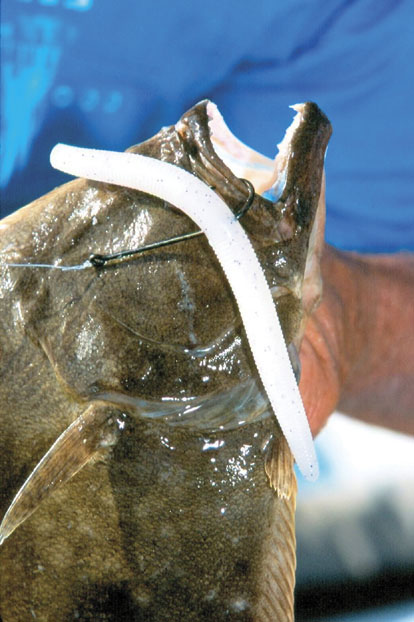
- To rig a wacky worm, simply run a hook through the bulbous "egg sack" on the side of a straight worm instead of through one end as in a "Texas rig." Anglers can also rig Gulp! Sinking Minnows and similar non-plastic baits wacky style. Drop the worm next to a shallow, weedy bank or other cover. Use no weight. Hooked in the middle, the wacky worm slowly sinks horizontally or with the ends tipped upward. As the worm sinks, the ends quiver and shake with tempting vibrations. Drifting with the tide, it simulates a wounded sand eel or dying baitfish.
- "That thing goes plumb crazy," said Ronnie Addison, a fisherman from Robert, Louisiana. "It has all kind of natural movement. It has sort of a swimming motion when it sinks. Both ends wobble. It shimmies and shakes. The ends of the worm fold back and almost touch each other in an undulating motion when you twitch the rod tip."
- Since flounder congregate around weedy shorelines that receive some tidal flow looking for baitfish to pop out of cover, throw a wacky worm as close to the bank as possible. Just let it sink naturally on a slack line. After it hits bottom, pop it back up to the surface, move it a few feet and let it sink again without creating any additional artificial action. Keep yo-yoing the worm out from the shoreline to the drop-off or work it along the shoreline. Fish usually bite quickly as it falls or not at all, so don't waste time on an unproductive spot. In the right spot, anglers could catch several without moving.
- "In a good spot, we sometimes catch four of five in a row and then maybe go through a little lull," said Capt. Erik Rue of Lake Charles, Louisiana. "A little while later, we might catch four or five more flounder. I look for bayous with good clean water and baitfish with some tidal flow. I like an incoming tide that pushes bait into the marsh."
- Other anglers prefer falling tides. A falling tide drains marshy ponds, flushing baitfish and shrimp from cover into deeper water. At the mouths of these tributaries, flounder face upstream, looking for bait to flow over their heads. Throw worms upstream as close to cover as possible and let them float with the tide like natural forage washed into the current. Only use the reel to recover slack line.
- "When I'm in shallow water, I look for little ditches on an outgoing tide," said Capt. Scott Simpson of Long Beach, Mississippi. "Flounder stack up at the mouths of these little ditches waiting to ambush anything that comes out with the current. I cast as far upstream as possible and let the current slowly work it downstream. The tide makes it tumble and wobble like a free-floating sand worm. As it tumbles over a flounder's head, it goes for it because it's such a natural presentation. It just looks so natural that the flounder is not going to be able to resist it."
- "Sometimes, I don't even feel the hit; it just feels like it's hung up or I see the line moving," Simpson said. "When I feel that distinctive tap, tap, I stop and lower the rod. Then, I take about two or three cranks on the reel to retrieve the slack and slowly bring the rod back up until the line is taught. When I know the flounder has the bait in his mouth, I lower the rod tip just a bit more and set the hook."
- Since flounder often congregate in weedy areas or along marshy shorelines, anglers sometimes need a rig that won't snag the vegetation. To make a wacky worm weedless, attach a rubber band under the barb of a hook. String it to the eye to form a simple, flexible weed guard. People can also buy factory hooks already equipped with wire weed guards.
- "Sometimes, people make the mistake of sticking close to the bank for too long," Skip said. "Flounder constantly look up. At night or early in the morning, they go into clear, shallow water. During bright days, they don't like looking at the sun, so they prefer water with a little bit of murk to it to filter out the sun or they move into deeper water off the edges of the drops. Bigger flounder are usually in slightly deeper water. They drop off to the second break in two to four feet of water, where the sunlight is not as intense."
- "Flounder bite for two reasons - intrusion of domain or hunger," Skip said. "Unlike specks or reds, they won't go chasing baits. Anglers need to get close to the bank and put the baits right on top of the flounder. Put a bait in the bite window and it will hit."
- A flounder might strike something that almost lands on it, but refuse to reveal its hiding spot to attack a morsel several feet away. Therefore, anglers need pinpoint accuracy to target specific pockets between reeds or grass blades. For nonaggressive fish, lure placement means more than color or lure selection.
- Anglers can also use wacky worms around obstructions in open water. A bridge piling, rock pile, old log, sunken boat, sandbar, jetty, dock or other object might break the current. Eddies form on the backside of such structure. Baitfish sometimes hide in these slack spots to escape the current. Such current breaks make excellent places for flounder to ambush prey. Flip a wacky worm into these pockets or drop one just upstream and let the tide naturally carry it around the obstruction into the eddy.
- Because of the slow sink rate, most people use wacky worms in water less than five feet deep. To fish deeper holes, some people attach small split-shots to the line, but that tends to make the bait fall "head first" instead of with that characteristically slow and tantalizing quiver. For a faster sink rate while retaining the natural action, anglers could use larger hooks or attach some malleable Sticky Weight to the hooks.
- Any honeyhole that might hold a flounder or two makes an excellent place to drop a wacky worm. When the jigs and baits won't work, sometimes the best anglers get a little wacky to catch more fish.
- Sources
- · Sabine Lake Guide Service
- Orange, TX - 409-960-6418
- www.comefishsabinelake.com
- · Capt. Erik Rue
- Lake Charles, LA - 337-598-4700
- www.calcasieucharters.com
- · Capt. Scott Simpson
- Long Beach, MS - 228-669-6204
- myweb.cableone.net/captscott/index.htm
- To rig a wacky worm, simply run a hook through the bulbous "egg sack" on the side of a straight worm instead of through one end as in a "Texas rig." Anglers can also rig Gulp! Sinking Minnows and similar non-plastic baits wacky style. Drop the worm next to a shallow, weedy bank or other cover. Use no weight. Hooked in the middle, the wacky worm slowly sinks horizontally or with the ends tipped upward. As the worm sinks, the ends quiver and shake with tempting vibrations. Drifting with the tide, it simulates a wounded sand eel or dying baitfish.