
The Saltwater Magazine for Gulf Coast Fishing!
Search Gulf Coast Fisherman's
Web Site
Past articles, specific
places or fish, etc.

TRIBUTARY TROUT
Top Winter Tactics for South Mississippi
by Capt. Robert L. Brodie
Team Brodie Charters

| CURRENT
MOON lunar phases |
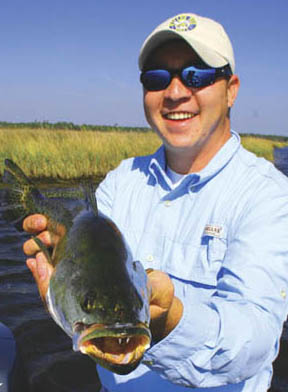
Winter has finally set in, and now south Mississippi anglers can expect a flurry of cold fronts from now through March. However, the chill of winter doesn't mean the bite on speckled trout, redfish, sheepshead, and black drum is off, no, not for a minute. Some of the best inshore angling can occur during these colder months, and anglers that are willing to brave the colder elements have a good chance to find these fish concentrated in areas of deeper water.
The Back Bay of Biloxi gave up good catches of fish from September through November of 2008, but as the winter conditions worsen, an angler can expect to find most of these fish, especially the speckled trout and redfish to leave the open waters of the bay and migrate up its tributaries. In the tributaries, including bayous, rivers, and connecting lakes, a combination of deep bends, holes, as well as various drop offs and ledges will attract cold weather migrants.
Some of the more noted tributaries that connect to the Back Bay of Biloxi include: the Biloxi River, Tchoutacabouffa River, Old Fort Bayou, Gulfport Lake, and Bernard Bayou. Fort Bayou is located on the northeastern end of the Back Bay of Biloxi, and it's full of bends associated with deep holes and adjacent flats. Gary Gardner of Vancleave, MS grew up fishing this fish rich bayou with his father, and knows it like the back of his hand.
Gary Gardner on Old Fort Bayou
Although Gardner is a dyed-in-the-wool bass fisherman, many of his angling skills honed from bass fishing is applied to catching winter speckled trout and redfish. Trying to get specific fishing sites out of these well-seasoned anglers is almost impossible, but most are willing to send you in the right direction with types of areas to look for, baits, and fishing techniques. Gardner catches plenty of big wintertime specks, but unlike most anglers that lean toward live bait or soft-plastic jigs, Gary is a topwater specialist.
Having fished with Gary on numerous occasions it's easy to see why he's partial to topwater baits. When the big trout blow up on the surface plugs, and you see the huge swirl and gulping sound made by a big trout's mouth, well, it quite obvious why he's partial to top-water plugs. A slow retrieve is needed to catch the biggest of trout, and plenty of casts and a lot of patience separates the average angler from the most productive fisherman. During the coldest of months, anglers fishing from the Fort Bayou Bridge well past the I-10 Interstate Bridge will have plenty of bends, ditches, flats, and long stretches of protected waters to find specks and reds.
Some anglers prefer to slow troll MirrOlures, Gulp Shrimp, D.O.A. Shrimp, and various soft-plastics. Slow trolling is an age-old technique that's quite relaxing, yet extremely exciting once a concentration of fish are located. Sometimes multiple fish are hooked an the same time, and anglers then pass pack through the area over and over until the bite plays out. However, other fishermen will ease back up to the area where the fish were hooked and proceed to either anchor up, drift, or use the trolling motor to work the area.
According to Gary, "For best results concentrate your efforts in the bends and at the mouth of ditches and bayous that dump into the main bayou. Plenty of my winter trout and reds will be caught on shallow flats, but they will be located next to a deep drop off, channel, or hole. Slow down the retrieve, especially if a trout begins to boil around the bait, and work it carefully all the way back to the boat." And don't be surprised if you encounter a big redfish or striped bass, two species that become extremely active during the winter months in this fish filled bayou. As for top-water baits, Gary likes to toss MirrOlure She Dogs, Zara Spooks, and Rapalas.
Back on the extreme opposite end of the Back Bay of Biloxi lies the twisting and turning water system called Bernard Bayou. Running from east to west, the bayou is entered after leaving the south western end of Big Lake. Like most of these coastal waterways, Bernard Bayou offers a wealth of fishing environs. Plenty of healthy marsh surrounds this bayou and its gauntlet of bends. Once you travel this bayou it's easy to pick up on all the areas that might hold fish.
Ross Maxwell On Bernard Bayou & Gulfport Lake
A coastal angler that knows this bayou quite well is Ross Maxwell of Biloxi, MS. Maxwell has been fishing these waters for most of his life, and through experience has learned a number of "hot spots" that produce for him during the cold chill of winter. Like Gardner, Maxwell has his favorite technique for catching his limit of winter specks. Ross likes to fish a 3-inch Berkley Gulp Shrimp in the pearl white, and he threads them on a 1/8-ounce unpainted jig head.
Ross stated, "During periods of cold weather I catch most of my fish slowly working the Gulp along the bottom. Trout are rather lethargic during the cold periods, and by slowly bumping the bait along the bottom it gives the fish a chance to suck in the offering. The bite will often resemble the bite of a bass, a speck will pick up the bait and slowly swim away with it. For me, a falling to low tide produces best, however as long as there is a tidal movement a good bite may occur."
Maxwell continued, "Some of my favorite sites to look for are points with a flat that drops off into a deep river bend or channel. Generally, I stay 30-feet or so out and cast back toward the point, and them work the bait down along the drop off. And again, the key to success is being able to work the bait slow." Having fished with Ross it's easy to see how his patience, and relentless casting leads to fish catching success.
With Ross, well, it's like a hunt, constantly moving from spot to spot picking up a few fish here and there, or eventually finding a heavy concentration of fish and quickly catching a limit of 15 specks.
Keeping his reel spooled with fluorocarbon line, Ross ties the jig directly to his main line. Also, his preferred jig sports a short shank gold hook, and is confident in using an unpainted jig head. A trolling motor is used to quietly move about and keep on the fish, and he may anchor up at times once a big concentration of fish are located.
If the bends of Bernard Bayou aren't enough water to keep your rods bent, well, just run the length of the bayou out to where it dumps into the Industrial Canal, an area located at the entrance to Gulfport Lake. A wide open lake that's part of Bernard Bayou, here anglers can find plenty of fishy sites to locate winter specks and reds. You'll find anglers fishing all along the shorelines of this lake. Many will be anchored up just west of the island to the south of the lake's entrance.
If live shrimp are available expect to see anglers suspending the lively crustaceans under a noisy popping cork. However, there will be many anglers working the shorelines with a trolling motor, and catching fish while tossing jerk baits, soft-plastics and Gulps. Of course there are still the old-school fishermen that prefer the art of slow trolling, and this big lake offers plenty of water for such a technique. Many anglers will troll 2 to 4 lines well behind the boat staggering each so that it's possible to make wide turns, thus keeping tangled lines to a minimum.
Ross also stated that he's caught trout under gulls in the lake, as well as in the Industrial Canal, and that good night fishing can occur under the lights of the Cowan Road Bridge that spans the lengthy canal. Of course the lake holds a good population of freshwater catfish, black drum, and striped bass patrol these waters during the cold months too. As for stripers, a silver or white-hued lure such as a Rattle-Trap, Yo-Zuri Rattlin Vibe, or slow-sink MirrOlures are excellent offerings.
Major Coastal Rivers Attract Specks & Reds, Too
Also, let's not forget the Biloxi River and Tchoutacabouffa River that dump their tidal waters into Big Lake, and eventually into the Back Bay of Biloxi. The Biloxi Rivers offers numerous points and bayou mouths with adjacent drop offs that hold wintertime fish, as well as Ditch Bayou, and the Jack Watson Power Plant Canal. At times, an angler might catch speckled trout, flounder, white trout, redfish, black drum, sheepshead, largemouth bass, striped bass, as well as a variety of bream near the end of the canal. And if you're lucky, well, you might even luck into a small tarpon.
The deep water and concrete rubble lined shores of the Jack Watson Power Plant Canal can produce well at times too. Either free lining live shrimp or slow-trolling can be effective in these waters, and there have been numerous striped bass in the 20-pound plus class taken each winter out of this big straight away of protected water. Largemouth bass like to linger about the concrete rubble, and by slowly working the structure a catch of bass can be added to the creel, or just caught for fun.
A bit farther up the river from the plant anglers can find excellent speck fishing near the mouth of Fritz Creek, and the numerous points along this beautiful shoreline. And let's not take the massive Tchoutacabouffa River for granted. This is a huge river system, and from where it empties into Big Lake well up river to the Cedar Lake Bridge, speckled trout are readily caught during cold weather. Matter a fact, for most of these rivers and bayous, the higher the salinity level the farther specks and reds will migrate up the rivers.
A few areas noted for cold weather specks on the Tchoutacabouffa include: off the mouth of Camp 4 Jacks Bayou; in the deeper waters of Parker Creek, an offshoot of the river where slow trolling and free-lining live baits are effective; the northern shoreline from Parkers Creek up the river to the fist big bend; and the northern shoreline just above and below the Cedar Lake Bridge.
Yet on the other hand if we should receive a large amount of rainfall causing the salinity to drop, then expect fish to move down river until the salinity levels once again become favorable, especially for the speckled trout. In the past there have been occasions where the freshwater has chased the specks well back into the Back Bay of Biloxi, even out of the bay to areas around Deer Island, and along deep water areas along the front beach.
However, for the most part conditions get back to normal in a week or so, and once again anglers can fish the upper regions with success. And remember, the key word to cold weather fishing in these backwaters is "slow". No matter if it's a topwater plug dancing the walk-the-dog jitter, or a jig bumping along the bottom keep the forward progress at a snails pace.
Not only will it set up more strikes from docile fish, but it will increase the hook up ratio. So there you have it, a rundown of some of the best wintertime fishing haunts that connect to the Back Bay of Biloxi, one of south Mississippi's more noted inshore fishing gems. Hey, it's just a matter of bundling up to face winter's harsh elements, and taking advantage of these fish filled waters.
Good wintertime fishing!